

FlashForge is a 3D printing brand known for producing desktop and professional 3D printers designed for hobbyists, makers, educators, designers, and businesses. The company offers printers aimed at everything from beginner-friendly home projects to more advanced 3D printing applications.
In this FlashForge review, we’ll look at its 3D printers, print quality, ease of use, features, materials, software, pricing, and overall value.
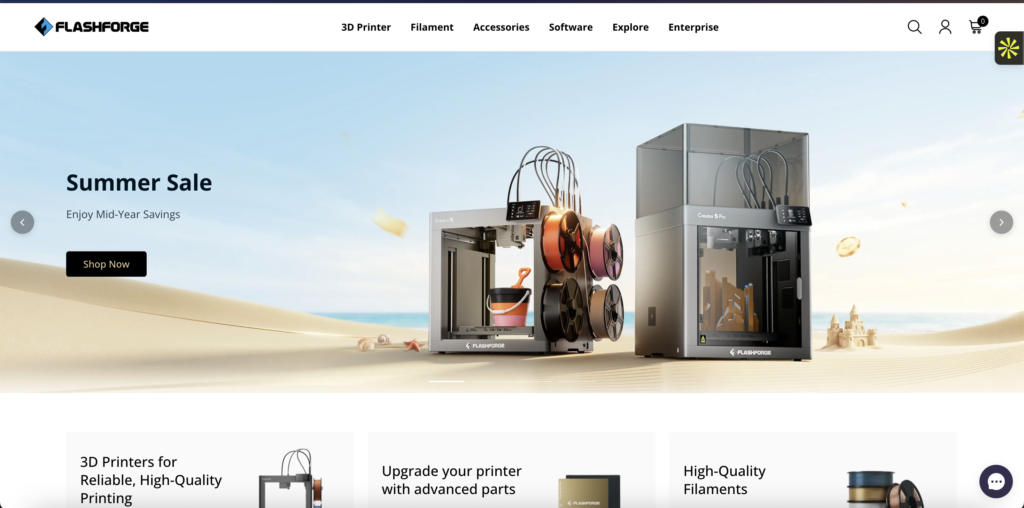
About FlashForge
FlashForge specializes in 3D printing technology, offering a range of printers and related accessories.
Its products can include:
- FDM/FFF 3D printers
- Enclosed 3D printers
- High-speed printers
- Multi-material printing systems
- Resin 3D printing solutions
- Filaments
- Replacement parts
- Printing accessories
The range caters to different experience levels, from people starting their first 3D printing project to users looking for more advanced capabilities.
What Makes FlashForge Different?
One of FlashForge’s key strengths is its focus on making 3D printing more accessible while still offering machines with advanced capabilities.
Depending on the model, features may include:
- High-speed printing
- Automatic bed leveling
- Enclosed printing chambers
- Dual or multi-color/multi-material printing
- Touchscreen controls
- Camera monitoring
- Remote printing management
- Automatic calibration
- Heated build platforms
The exact features vary considerably between models.
Print Quality
Print quality is one of the most important factors when choosing a 3D printer.
FlashForge printers can produce detailed models suitable for applications such as:
- Prototypes
- Functional parts
- Miniatures
- Educational projects
- Home décor
- Engineering models
- Product development
Final print quality depends on the printer model, material, layer height, print speed, settings, and calibration.
For detailed prints, users may need to balance speed with resolution.
Printing Speed
Some newer FlashForge printers focus heavily on faster printing.
Higher print speeds can be useful when producing:
- Prototypes
- Multiple components
- Larger models
- Iterative designs
However, maximum advertised speed doesn’t necessarily represent the ideal speed for every material or model. Print quality, geometry, and material characteristics can affect the practical printing speed.
Ease of Use
FlashForge offers several printers designed to reduce the technical complexity traditionally associated with 3D printing.
Depending on the model, features such as:
- Automatic leveling
- Calibration systems
- Guided setup
- Enclosed printing
- Remote monitoring
can make the process more approachable for beginners.
More advanced machines may still require users to understand slicing, filament settings, temperature, and print orientation.
Materials and Filament
FlashForge printers may support different types of 3D printing materials depending on the specific machine.
Common materials can include:
- PLA
- PETG
- ABS
- TPU
- Other engineering-grade filaments
Material compatibility should always be checked for the exact printer model.
For specialized materials, factors such as nozzle temperature, build-plate temperature, and enclosure requirements become increasingly important.
Enclosed 3D Printers
Enclosed printers can provide advantages when working with materials that are more sensitive to temperature changes.
An enclosure can help with:
- Temperature stability
- Reducing drafts
- Managing certain printing materials
- Keeping the printing area contained
It can also be useful in educational or home environments where keeping the printer more enclosed is desirable.
Multi-Color and Multi-Material Printing
Selected FlashForge systems support multi-color or multi-material printing.
This can be useful for:
- Colorful models
- Decorative objects
- Complex prototypes
- Models requiring support materials
- Functional parts using different materials
Multi-material printing can add versatility, although it can also increase material usage and printing complexity.
Software and Connectivity
Depending on the printer, FlashForge provides software and connectivity options for preparing and managing prints.
Users may be able to:
- Prepare models for printing
- Adjust print settings
- Send files to the printer
- Monitor printing
- Manage multiple printers
Network and remote-management capabilities can be particularly useful for users running several machines.
Pricing and Overall Value
FlashForge offers printers across different price categories, so the value depends heavily on the model.
When comparing a FlashForge printer, consider:
- Print speed
- Build volume
- Supported materials
- Automation features
- Multi-color capabilities
- Enclosure
- Software
- Connectivity
- Replacement parts
- Warranty and support
A more expensive printer may be worthwhile if you need faster printing, larger models, advanced materials, or greater automation.
Who Should Consider FlashForge?
FlashForge may be a good choice for:
- 3D printing beginners
- Hobbyists
- Makers
- Students and educators
- Designers
- Engineers
- Small businesses
- Product prototyping
- Users interested in multi-color or advanced printing
It may be less suitable for someone looking for the absolute lowest-cost entry into 3D printing.
Is FlashForge Worth It?
FlashForge can be worth considering if you want a 3D printer that combines accessible features with options for more advanced printing.
Its potential advantages include:
- A broad range of printers
- Beginner-friendly features
- High-speed models
- Enclosed printing options
- Multi-material capabilities on selected systems
- Different printer sizes and price points
- Software and connectivity features
Before purchasing, compare the exact model’s:
- Build volume
- Supported materials
- Print speed
- Nozzle and temperature specifications
- Automatic calibration features
- Software compatibility
- Warranty
- Replacement-part availability
Final Verdict
FlashForge is a well-established option for people looking to enter or expand their 3D printing setup. Its range includes accessible desktop printers as well as more feature-rich machines for users who need greater speed, automation, or material flexibility.
The best choice depends on what you intend to print and how much control you want over the printing process.
Overall, this FlashForge Review finds that FlashForge is worth considering for hobbyists, beginners, educators, designers, and businesses looking for capable 3D printers with a balance of ease of use, print quality, and advanced features.